
Mar 21, 2026
BIR Employee Withholding Tax Table Philippines 2026
How to compute BIR withholding tax for Philippine employees. TRAIN Law brackets, step-by-step computation, and common mistakes to avoid.
You're running payroll and one of your staff asks why her tax went up this cutoff. She worked overtime last period, and now the withholding looks different. You open the BIR tax table, stare at the brackets, and realize you're not sure whether to annualize first or apply the rate directly. The numbers need to be right before payday, and payday is tomorrow.
Withholding tax is the most calculation-heavy part of Philippine payroll. The brackets are progressive, the computation involves annualization, and the amount shifts when overtime or holiday pay changes someone's income for the period. Here's how to get it right.
The TRAIN Law brackets
The current income tax rates come from the TRAIN Law (Republic Act No. 10963), which took full effect in 2023. These brackets apply for 2026:
| Taxable Income (Annual) | Tax Rate |
|---|---|
| ₱250,000 and below | 0% |
| Over ₱250,000 to ₱400,000 | 15% of excess over ₱250,000 |
| Over ₱400,000 to ₱800,000 | ₱22,500 + 20% of excess over ₱400,000 |
| Over ₱800,000 to ₱2,000,000 | ₱102,500 + 25% of excess over ₱800,000 |
| Over ₱2,000,000 to ₱8,000,000 | ₱402,500 + 30% of excess over ₱2,000,000 |
| Over ₱8,000,000 | ₱2,202,500 + 35% of excess over ₱8,000,000 |
The first ₱250,000 of annual taxable income is completely tax-free. For many minimum-wage team members, this means zero withholding tax.
How taxable income is computed
Taxable income is not the same as gross pay. Not all compensation is taxable, and the computation depends on whether the employee is a minimum wage earner or not.
Minimum wage earners
Employees paid the DOLE-mandated statutory minimum wage for their region are completely exempt from income tax. The exemption covers their basic pay, holiday pay, overtime pay, night shift differential, and hazard pay.
If an employee qualifies as a minimum wage earner, withholding tax is zero. No need to apply the tax table at all.
The exemption holds as long as the employee's basic pay does not exceed the regional minimum wage set by the RTWPB. A raise above the minimum — even a small one — means the employee loses MWE status and taxable income must be determined under normal rules, with permitted exclusions (qualified de minimis benefits, 13th-month pay within the ₱90,000 threshold, and other applicable non-taxable items) subtracted before applying the regular tax table.
Non-minimum wage earners
For employees earning above minimum wage, two things happen before applying the tax table:
1. Remove non-taxable compensation.
Not everything in the payslip is taxable. The following are excluded:
De minimis benefits are small-value benefits that the BIR allows employers to give tax-free, each with its own ceiling under RR 29-2025 (effective January 6, 2026):
| Benefit | Tax-Exempt Limit |
|---|---|
| Rice subsidy | Up to ₱2,500/month |
| Uniform and clothing allowance | Up to ₱8,000/year |
| Medical cash allowance for dependents | Up to ₱2,000/semester |
| Actual medical assistance | Up to ₱12,000/year |
| Laundry allowance | Up to ₱400/month |
| Employee achievement awards | Up to ₱12,000/year |
| Christmas and major anniversary gifts | Up to ₱6,000/year |
| Monetized unused vacation leave (private) | Up to 12 days/year |
| Daily meal allowance (overtime/night/graveyard) | Tax-exempt up to 30% of the basic minimum wage for minimum wage earners (per RR 29-2025) |
Amounts within each ceiling are completely non-taxable. They are not counted toward the ₱90,000 threshold below. De minimis benefits are also not included in SSS, PhilHealth, or Pag-IBIG computation.
If a de minimis benefit exceeds its individual ceiling, only the excess spills over into the ₱90,000 pool below.
13th-month pay and other benefits are tax-exempt up to a combined total of ₱90,000 per year. This pool includes:
- 13th-month pay
- Christmas bonus
- Productivity incentives and other similar bonuses
- Any de minimis excess that went over individual ceilings
The 13th-month pay by itself is not taxable. It only becomes partially taxable if, combined with all other items in this pool, the annual total exceeds ₱90,000. Only the amount above ₱90,000 gets added to taxable compensation.
2. Subtract mandatory contributions.
After removing the non-taxable items, deduct the employee's share of SSS, PhilHealth, and Pag-IBIG.
The complete formula:
Taxable income = Gross compensation − Non-taxable items − SSS − PhilHealth − Pag-IBIG
For an employee whose pay period is purely basic salary with no de minimis benefits or bonuses (like Carlo in Example 3 below), this simplifies to gross minus contributions. But the moment rice subsidies, clothing allowances, or bonuses enter the picture, the full formula applies.
Step-by-step computation
Most Philippine businesses pay semi-monthly (24 pay periods per year). Here's the process for each cutoff:
MWE path. If the employee is a minimum wage earner (MWE), withholding tax is zero. No tax-table steps are needed — skip straight to filing. SSS, PhilHealth, and Pag-IBIG contributions still apply.
Non-MWE path. For employees above the regional minimum wage:
- Determine gross pay for the pay period.
- Subtract non-taxable compensation — qualified de minimis benefits within their ceilings, and 13th-month pay or bonuses within the ₱90,000 annual threshold.
- Subtract mandatory contributions (SSS, PhilHealth, Pag-IBIG employee shares).
- The result is taxable income for the period.
- Annualize the taxable income (multiply by 24 for semi-monthly).
- Apply the tax-table steps: find the correct bracket, compute the annual tax.
- De-annualize (divide by 24) to get the withholding for the pay period.
Worked examples
Example 1: Minimum wage earner (zero tax)
Joy works as a crew member at a restaurant in Metro Manila. She earns the NCR minimum wage of ₱695 per day.
Monthly gross: ₱695 × 26 working days = ₱18,070
Joy qualifies as a statutory minimum wage earner. Her entire compensation is exempt from income tax — including overtime pay, holiday pay, night shift differential, and hazard pay.
Withholding tax: ₱0.00
SSS, PhilHealth, and Pag-IBIG contributions still apply — those are social insurance, not income tax. But no amount is withheld for income tax.
If Joy's employer gives her a raise above ₱695/day, she loses MWE status. At that point, taxable income must be determined under normal rules — permitted exclusions like de minimis benefits still apply — and the employer needs to start withholding.
Note: Minimum wage rates vary by region and are updated through RTWPB wage orders. Always check the current rate for your region.
Example 2: Non-MWE with de minimis benefits
Anna earns ₱15,000 per semi-monthly cutoff (₱30,000/month gross). Her employer gives her a ₱2,000/month rice subsidy.
The rice subsidy is a de minimis benefit. The BIR ceiling under RR 29-2025 is ₱2,500/month, so Anna's ₱2,000 is within the limit. It is completely non-taxable — not included in her taxable compensation and not included in her SSS, PhilHealth, or Pag-IBIG computation.
Her mandatory contributions per cutoff (based on ₱30,000/month gross only):
- SSS: ₱750
- PhilHealth: ₱375
- Pag-IBIG: ₱100
- Total deductions: ₱1,225
Taxable income per cutoff: ₱15,000 − ₱1,225 = ₱13,775
Annualized: ₱13,775 × 24 = ₱330,600
This falls in the "Over ₱250,000 to ₱400,000" bracket:
Tax = 15% of (₱330,600 − ₱250,000) Tax = 15% of ₱80,600 Annual tax = ₱12,090
Per cutoff: ₱12,090 / 24 = ₱503.75
Anna's withholding tax is ₱503.75 per semi-monthly pay period. The ₱2,000 rice subsidy had no effect on the computation — as it should be.
If the employer had mistakenly included the rice subsidy in Anna's taxable compensation, the annualized income would jump to ₱354,600 and the withholding would be higher every single cutoff.
Example 3: Non-MWE, basic salary only
Carlo earns ₱25,000 per semi-monthly cutoff (₱50,000/month gross). His compensation for this period is purely basic salary — no de minimis benefits, bonuses, or 13th-month pay. So the only deductions before tax are his mandatory contributions.
His mandatory contributions per cutoff:
- SSS: ₱875
- PhilHealth: ₱625
- Pag-IBIG: ₱100
- Total deductions: ₱1,600
Taxable income per cutoff: ₱25,000 − ₱1,600 = ₱23,400
Annualized taxable income: ₱23,400 × 24 = ₱561,600
This falls in the "Over ₱400,000 to ₱800,000" bracket:
Tax = ₱22,500 + 20% of (₱561,600 − ₱400,000) Tax = ₱22,500 + 20% of ₱161,600 Tax = ₱22,500 + ₱32,320 Annual tax = ₱54,820
Per cutoff: ₱54,820 / 24 = ₱2,284.17
Carlo's withholding tax is ₱2,284.17 per semi-monthly pay period.
The ₱250,000 threshold
Under the TRAIN Law, anyone whose annual taxable income is ₱250,000 or less pays zero income tax. That works out to roughly ₱10,417 in taxable income per semi-monthly cutoff.
This is separate from the MWE exemption. Minimum wage earners are exempt because of their wage classification, regardless of the ₱250,000 threshold. Non-MWEs whose taxable income (after removing non-taxable items and contributions) still falls at or below ₱250,000 also pay zero tax — but through the graduated bracket, not the MWE exemption.
Either way, you still need to run the computation each period because overtime pay, holiday premiums, or bonuses can push the annualized amount above the threshold.
Common mistakes
Not deducting contributions first. SSS, PhilHealth, and Pag-IBIG must be subtracted before applying the tax table. Computing tax on gross pay inflates every team member's withholding.
Misunderstanding progressive brackets. Each bracket only applies to the income within that range, not the entire amount. Someone earning ₱561,600 annually doesn't pay 20% on all of it. They pay 0% on the first ₱250,000, 15% on the next ₱150,000, and 20% on the remaining ₱161,600.
Applying a flat rate. Some owners apply a single percentage to everyone regardless of income level. This undertaxes higher earners and overtaxes lower earners, and it creates problems at year-end reconciliation with the BIR.
Ignoring mid-year changes. A raise, significant overtime, or a bonus can shift someone into a higher bracket. The withholding should adjust to reflect the new projected annual income, not stay fixed at the rate from January.
Withholding tax on minimum wage earners. MWEs are fully exempt from income tax — including their holiday pay, overtime, night differential, and hazard pay. If an employee is paid the regional minimum wage, withholding should be zero. Watch for regional wage order updates that change the threshold, and check whether any raises push the employee above it.
Taxing de minimis benefits or misapplying the ₱90,000 threshold. De minimis benefits within their BIR-prescribed ceilings (RR 29-2025) are completely non-taxable and are not counted toward the ₱90,000 threshold. The ₱90,000 covers 13th-month pay, Christmas bonuses, productivity incentives, and any de minimis excess that went over individual ceilings. Only the total above ₱90,000 gets added to taxable compensation. Mixing up these two layers — or lumping de minimis into taxable pay — results in incorrect withholding.
Frequently asked questions
How much is the withholding tax for a ₱25,000 semi-monthly salary?
For a ₱25,000 semi-monthly salary (₱50,000/month), after deducting SSS, PhilHealth, and Pag-IBIG contributions of about ₱1,600, the taxable income per cutoff is ₱23,400. Annualized, that's ₱561,600 — falling in the "Over ₱400,000 to ₱800,000" bracket. The withholding tax comes out to approximately ₱2,284.17 per semi-monthly pay period.
Are minimum wage earners exempt from withholding tax?
Yes. Employees paid the DOLE-mandated statutory minimum wage for their region are completely exempt from income tax. The exemption covers basic pay, holiday pay, overtime pay, night shift differential, and hazard pay. If the employee receives a raise above the regional minimum wage, they lose MWE status and normal withholding rules apply.
What are the BIR income tax brackets for 2026 under the TRAIN Law?
The 2026 TRAIN Law brackets are: ₱250,000 and below = 0%; Over ₱250,000 to ₱400,000 = 15% of excess over ₱250,000; Over ₱400,000 to ₱800,000 = ₱22,500 + 20% of excess over ₱400,000; Over ₱800,000 to ₱2,000,000 = ₱102,500 + 25% of excess over ₱800,000; Over ₱2,000,000 to ₱8,000,000 = ₱402,500 + 30% of excess over ₱2,000,000; Over ₱8,000,000 = ₱2,202,500 + 35% of excess over ₱8,000,000.
Do you deduct SSS, PhilHealth, and Pag-IBIG before computing withholding tax?
Yes. Mandatory contributions (SSS, PhilHealth, and Pag-IBIG employee shares) must be subtracted from gross compensation before applying the tax table. The formula is: Taxable income = Gross compensation − Non-taxable items − SSS − PhilHealth − Pag-IBIG.
Are de minimis benefits subject to withholding tax?
No, as long as they are within the BIR-prescribed ceilings under RR 29-2025. For example, rice subsidy up to ₱2,500/month and uniform allowance up to ₱8,000/year are completely non-taxable. Only amounts exceeding individual ceilings spill over into the ₱90,000 annual threshold for 13th-month pay and other benefits.
How do you annualize withholding tax for semi-monthly payroll?
Multiply the taxable income for the pay period by 24 (the number of semi-monthly pay periods per year). Apply the TRAIN Law tax brackets to the annualized amount, then divide the resulting annual tax by 24 to get the withholding per cutoff.
How Timekeep handles withholding tax
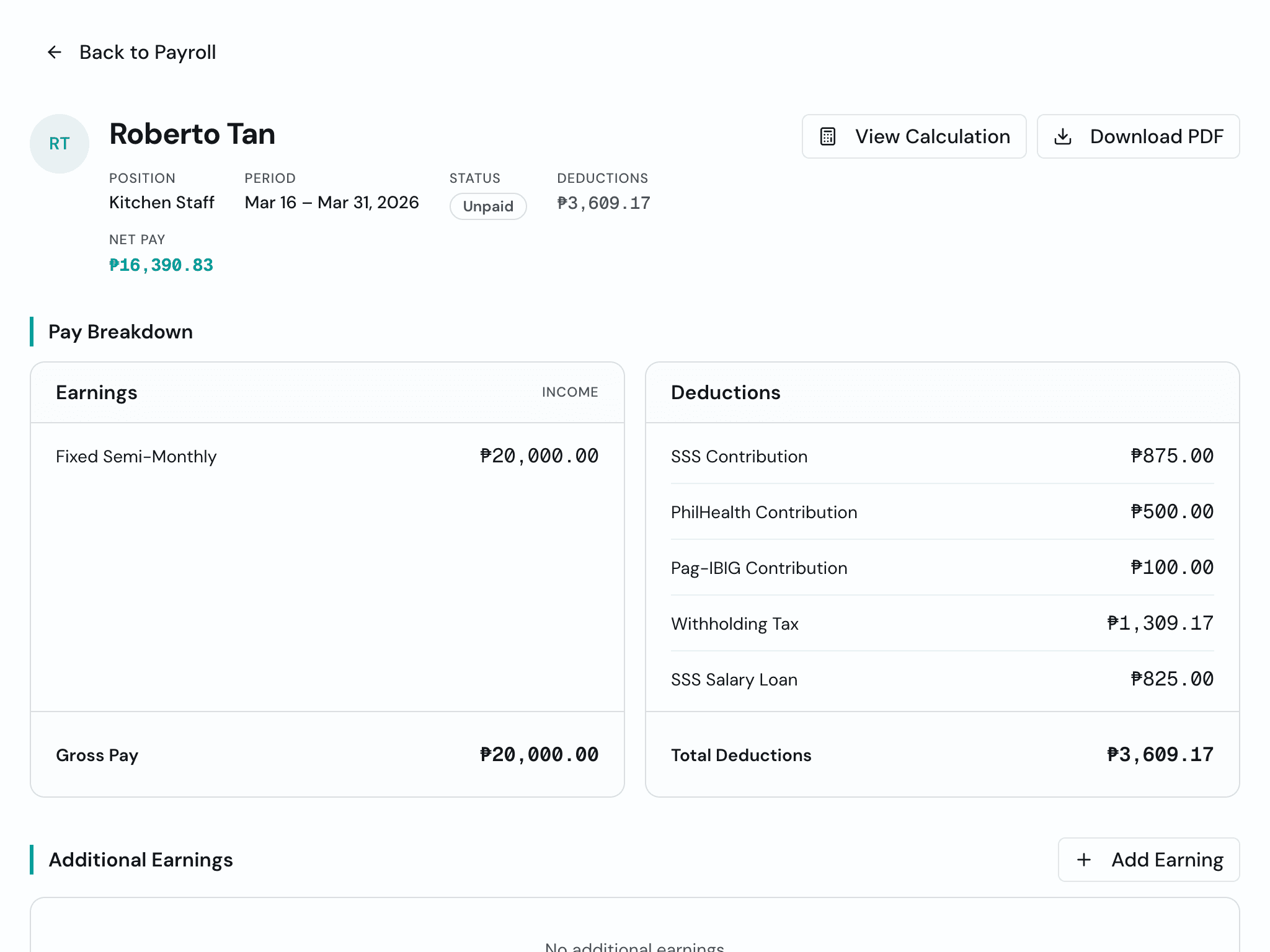
Timekeep computes BIR withholding tax automatically each pay period. It deducts SSS, PhilHealth, and Pag-IBIG first, annualizes the taxable income, applies the correct progressive bracket, and shows the result on the payslip. When a team member's compensation changes due to overtime or a raise, the computation adjusts for that period.
One less thing to compute at midnight
That staff member wondering why her tax changed? With the right system, the answer is on her payslip: overtime pushed her annualized income into the next bracket. Clear, accurate, and ready before payday.
Try it free for 30 days at timekeep.ph. No credit card required.