
Mar 27, 2026
Common Payroll Mistakes Philippine Small Businesses Make
Seven payroll mistakes that cost Philippine small businesses money and trigger penalties, from outdated contribution tables to missing payslips.
You've just finished payroll. The numbers look right, the bank transfers are queued, and you close your laptop feeling relieved. Then two months later, SSS sends a notice. You've been using last year's contribution table since January. Now you owe the difference, plus penalties.
It's the kind of mistake that doesn't announce itself. Most payroll errors are quiet. They compound over months, across dozens of staff, until an agency notice or an employee dispute makes them visible.
Why small mistakes turn into big problems
A ₱50 error per person per cutoff doesn't feel like much. But multiply that across 15 staff, 24 cutoffs a year, and you're looking at ₱18,000 in corrections. Add penalties and interest from government agencies, and the number climbs fast.
The tricky part is that Philippine payroll has layers. Government contributions, holiday pay matrices, tax sequencing, 13th month accruals. Each layer has its own rules, and the rules interact. Getting one layer wrong can cascade into the next.
Seven mistakes that keep coming up
Outdated SSS, PhilHealth, or Pag-IBIG tables
The SSS contribution table changes every few years. PhilHealth rates increase annually under the Universal Health Care Act. Pag-IBIG has its own brackets. When you're pulling rates from a bookmarked blog post or a saved PDF, there's no guarantee it's current.
Using last year's table means you under-deduct from your staff and under-remit to the agency. The agency still expects the correct amount. You end up covering the shortfall yourself or chasing people for the difference.
Wrong holiday pay rates
The Philippine holiday pay matrix has dozens of rate combinations. Regular holidays, special non-working days, rest days, and overtime each have different multipliers. A regular holiday that falls on a rest day where someone works overtime? That's 338% of the hourly rate.
The opposite error is just as common. Some owners pay 200% for worked special non-working days when the actual rate is 130%. That overpayment, repeated every holiday, adds up quietly.
Computing tax before deducting contributions
The order matters. Government contributions (SSS, PhilHealth, Pag-IBIG) come out of gross pay before you compute withholding tax. They reduce taxable income.
If you compute BIR tax on gross pay first and deduct contributions separately, your staff pays more tax than they should. They'll notice when they file their annual ITR and the numbers don't reconcile.
Late remittance to government agencies
Deducting contributions from pay is only half the job. You need to remit those deductions, plus the employer share, to each agency by their deadline. SSS remittance is due by the last day of the month following the applicable month. Miss it and you face a 2% per month penalty.
PhilHealth and Pag-IBIG have their own deadlines and penalty structures. Fall behind by a few months and the penalties alone can exceed what you owe in contributions.
Not providing payslips
DOLE requires payslips regardless of business size. The payslip must show gross pay, deductions, and net pay. It's not optional.
Some owners just transfer the net amount and move on. If a staff member files a complaint with DOLE, the absence of payslips is an immediate red flag that invites a deeper inspection of your entire payroll process.
Flat overtime rates
The standard overtime rate is 125% of the hourly rate for work beyond 8 hours on an ordinary day. But overtime on a rest day is 130% of the rest day rate. Overtime on holidays follows the holiday rate matrix. Night differential (10 PM to 6 AM) stacks on top of all of these.
The most common mistake is applying a flat 125% to all overtime regardless of the day type. This consistently underpays staff who work overtime on rest days and holidays.
Forgetting 13th month pay for separated staff
Thirteenth month pay is mandatory for all rank-and-file staff who have worked at least one month during the calendar year. This includes people who resigned, were terminated, or are on extended leave.
When someone leaves in March, they're entitled to 13th month pay proportional to the months they worked. Computing 13th month only for people still employed in December is a violation.
How Timekeep handles this
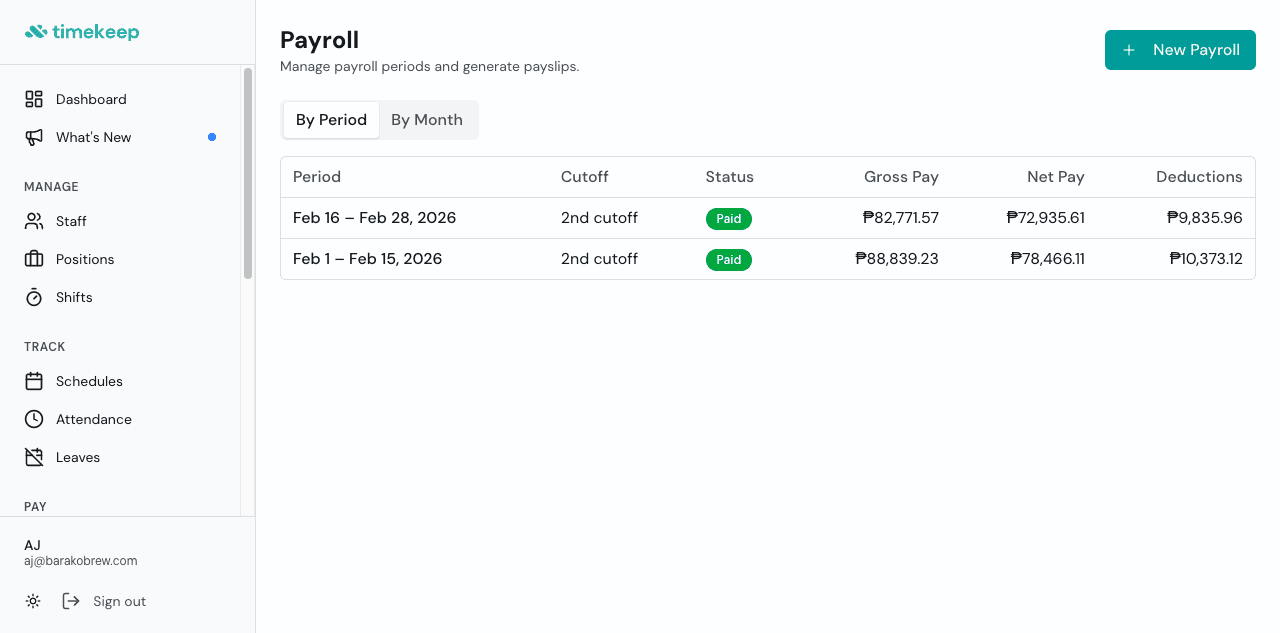
Timekeep ships updated contribution tables as soon as SSS, PhilHealth, and Pag-IBIG publish new rates. It applies the correct holiday pay multiplier based on the day type and rest day schedule, deducts contributions before computing tax, generates payslips for every payroll run, and computes overtime based on when the hours were actually rendered. The computation follows the rules so you can focus on reviewing the results.
The pattern behind all seven
These mistakes share a root cause: too many rules changing too often for anyone to track manually across every cutoff, every person, every month. Getting the structure right once means you stop fixing the same errors twice.
Try it free for 30 days at timekeep.ph. No credit card required.