
Mar 26, 2026
True Cost of Hiring an Employee in the Philippines
The true cost of hiring in the Philippines beyond salary. Employer SSS, PhilHealth, Pag-IBIG shares, 13th month pay, and real examples at two salary levels.
You're thinking about hiring your first barista. You've agreed on ₱15,000 a month. You budget ₱15,000, post the start date, and move on. Then your first payroll hits and you realize the business is actually spending closer to ₱18,000 for that one person, and you're not sure where the extra ₱3,000 came from.
It came from employer contributions. Philippine labor law requires businesses to pay SSS, PhilHealth, and Pag-IBIG shares on top of the salary, plus set aside money for 13th month pay. These costs aren't optional and they start from day one.
What makes up the total employer cost
The salary you agree on is just the starting number. Four mandatory costs sit on top of it.
Employer SSS share
The employer pays a share of each staff member's SSS contribution based on the SSS contribution table. The employer share is approximately 9.5% of the monthly salary credit (MSC), which includes the EC (Employees' Compensation) component. The staff member also pays their own share (about 4.5%), but that's deducted from their salary, not an additional cost to the business.
Employer PhilHealth share
PhilHealth contributions are split equally between employer and staff member. The current rate is 5% of basic monthly salary, with the employer paying half (2.5%) and the staff member paying the other half. There's a salary floor and ceiling that cap the contribution range.
Employer Pag-IBIG share
Pag-IBIG contributions are relatively small. For anyone earning over ₱1,500 per month (which is virtually everyone), the employer contributes ₱100 per month and the staff member contributes ₱100 per month. Some staff voluntarily contribute more, but the mandatory employer share is ₱100.
13th month pay
Philippine law requires employers to pay 13th month pay to all rank-and-file staff. It equals one-twelfth (1/12) of the total basic salary earned during the year. In practice, this means an extra month's pay, typically given in December.
For budgeting, set aside 8.33% of the monthly salary each month. That way the December payout doesn't come as a cash flow surprise.
Example: Staff member earning ₱15,000/month
| Cost component | Monthly amount |
|---|---|
| Basic salary | ₱15,000.00 |
| Employer SSS share (including EC) | ₱1,425.00 |
| Employer PhilHealth share (2.5%) | ₱375.00 |
| Employer Pag-IBIG share | ₱100.00 |
| 13th month pay provision (8.33%) | ₱1,250.00 |
| Total monthly employer cost | ₱18,150.00 |
The staff member takes home ₱15,000 minus their own SSS, PhilHealth, Pag-IBIG, and withholding tax deductions. But the business spends ₱18,150 per month. That's 21% more than the agreed salary.
Example: Staff member earning ₱25,000/month
| Cost component | Monthly amount |
|---|---|
| Basic salary | ₱25,000.00 |
| Employer SSS share (including EC) | ₱2,375.00 |
| Employer PhilHealth share (2.5%) | ₱625.00 |
| Employer Pag-IBIG share | ₱100.00 |
| 13th month pay provision (8.33%) | ₱2,083.33 |
| Total monthly employer cost | ₱30,183.33 |
At this level, the business pays about 20.7% above the base salary. The gap grows in absolute pesos as the salary goes up, though the percentage stays roughly similar because most components are proportional.
Other costs that can add up
The four items above are the legally mandated costs. Depending on your business, there may be more.
Overtime and premium pay. If someone regularly works overtime, rest days, or holidays, those premium rates add to your labor cost. A staff member earning ₱15,000 per month who works two Sundays at 130% rate costs more than the ₱18,150 baseline.
Service incentive leave. The law requires 5 days of paid service incentive leave per year for staff who have worked at least one year. Some businesses offer more. Paid leave doesn't add a new line item (the salary stays the same), but it means paying for time not worked, which affects your per-hour cost.
Separation pay. If you terminate someone for authorized causes (redundancy, retrenchment, closure), you owe separation pay. This isn't a monthly cost, but it should factor into your long-term employment budget.
Recruitment. Job postings, interviews, and onboarding take time. If you use a recruiter, their fee is typically one to two months' salary.
Why this matters before you hire
A business owner looking to bring on three people at ₱15,000 per month might budget ₱45,000 for salaries. The actual cost is closer to ₱54,450. That ₱9,450 difference per month, or ₱113,400 per year, is money that needs to come from somewhere.
Knowing the true number before you hire lets you set realistic prices, plan cash flow, and avoid the surprise of higher-than-expected payroll expenses in the first few months. It's not a reason to delay hiring. It's a reason to budget accurately.
How Timekeep shows the full picture
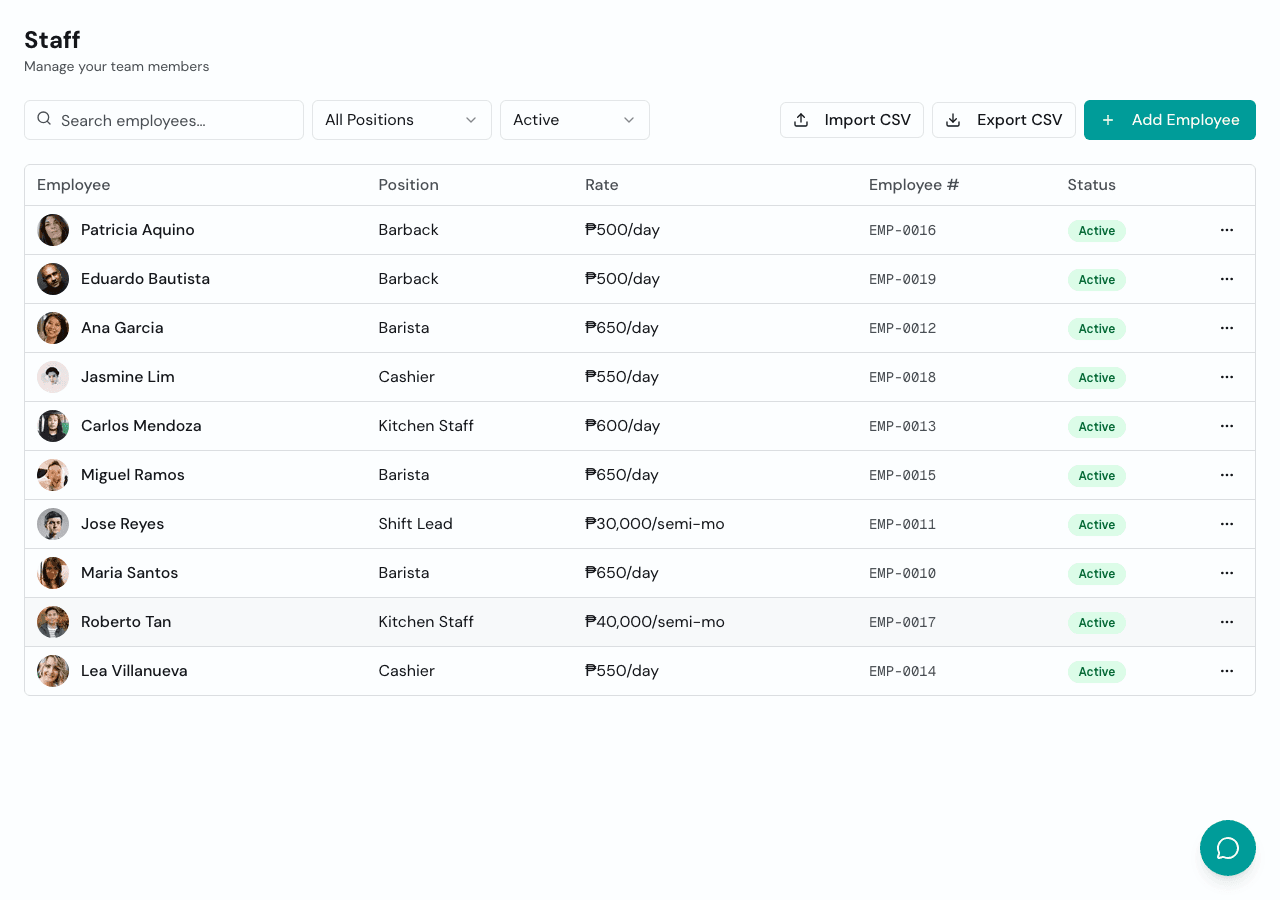
Timekeep's payroll reports break down total labor cost per staff member, showing the base salary alongside each employer contribution. When you run payroll, you see not just what the person takes home, but what the business actually spends. The employee detail page shows all active contributions and rates at a glance, making it straightforward to budget for your next hire.
Budget for the real number
That ₱15,000 barista costs the business ₱18,150. Knowing that from the start means no surprises on your first payroll run, and no scrambling to cover the gap between what you budgeted and what you actually owe.
Try it free for 30 days at timekeep.ph. No credit card required.