
Mar 19, 2026
Night Differential Pay Computation Rules Philippines
How to compute night differential pay under Philippine labor law. The 10% premium, qualifying hours, overtime stacking, and peso examples.
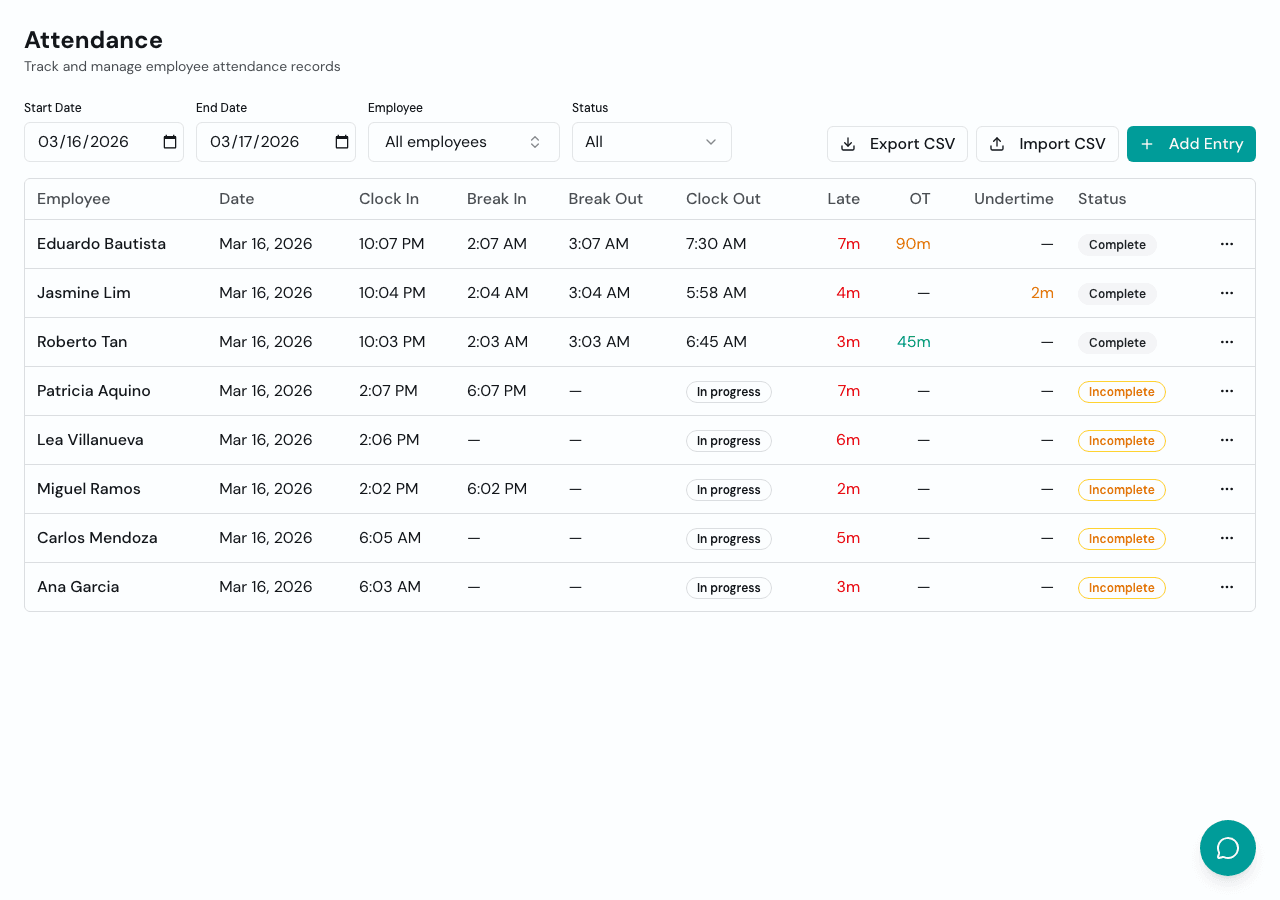
Your restaurant closes at midnight. Your closing crew clocks out around 12:30 AM, sometimes later. You've been paying them straight time for the whole shift, but a friend who runs a convenience store mentions he pays a night premium. You check, and he's right. Those hours after 10 PM carry an extra 10% under the Labor Code, and you've been missing it.
The premium per person per night is small. But across a full pay period with multiple staff, it adds up, and DOLE considers it mandatory.
The rule
Under Article 86 of the Labor Code, any work performed between 10:00 PM and 6:00 AM earns an additional 10% of the regular hourly rate. This is called night shift differential (NSD).
Night differential = hourly rate x 10% x NSD hours
The 10% is added on top of regular pay, not a replacement. It's extra.
A peso example
A team member earns ₱500/day. Their hourly rate is ₱62.50. They work 4 hours between 10 PM and 2 AM.
Night differential: ₱62.50 x 0.10 x 4 = ₱25.00
That ₱25.00 is added to their regular pay for those 4 hours (₱62.50 x 4 = ₱250.00). Total pay for the night hours: ₱275.00.
Which hours qualify
The NSD window is exactly 10:00 PM to 6:00 AM. Only the hours and minutes that fall inside this window count.
If a team member's shift runs from 6:00 PM to 2:00 AM, only the 4 hours from 10 PM to 2 AM get the differential. The hours from 6 PM to 10 PM are paid at the regular rate.
A shift running the full 10 PM to 6 AM means all 8 hours qualify. Minutes count too: someone who works until 10:30 PM earns the NSD premium for 30 minutes.
Who is covered
Night differential applies to all employees. The only exception under DOLE guidelines is for retail and service establishments with fewer than 5 workers. In practice, most small businesses pay it regardless because the 10% premium is modest and the risk of a labor complaint isn't worth the savings.
How NSD stacks with overtime
When night hours are also overtime hours (beyond 8 hours in a day), both premiums apply. Compute the overtime rate first, then add the 10% night differential on top.
Night OT rate = hourly rate x 1.25 x 1.10 = hourly rate x 1.375
For a ₱500/day team member (₱62.50/hour) working 2 overtime hours between 10 PM and midnight:
Night OT rate: ₱62.50 x 1.375 = ₱85.94/hour Night OT pay: ₱85.94 x 2 = ₱171.88
How NSD stacks with holidays
The same stacking logic applies. Compute the holiday rate first, then add 10%.
Regular holiday night rate = hourly rate x 2.00 x 1.10 = hourly rate x 2.20
For a ₱500/day team member working a regular holiday night shift from 10 PM to 6 AM (8 hours):
Night rate: ₱62.50 x 2.20 = ₱137.50/hour Pay for the shift: ₱137.50 x 8 = ₱1,100.00
Common scenarios for small businesses
Restaurant closing shift. A restaurant that closes at midnight has staff working 3 PM to 11 PM. Only the hour from 10 PM to 11 PM qualifies. For a ₱500/day team member, that's an extra ₱6.25 per night. Multiply that across a full cutoff with several people on closing and it matters.
24-hour operations. Convenience stores, gas stations, and security agencies with graveyard shifts have staff in the full 10 PM to 6 AM window. All 8 hours get the premium.
Early morning shifts. A bakery with staff starting at 4 AM has people in the NSD window from 4 AM to 6 AM. Those 2 hours qualify for the 10% premium.
How Timekeep handles night differential
Timekeep tracks night differential automatically. When a team member clocks in or out during the NSD window, the system calculates the eligible minutes precisely. It handles shifts that span midnight, partial overlaps, and stacking with overtime or holiday rates. The NSD amount appears as a separate line on each payslip so staff can verify exactly what they earned.
Those closing shifts add up
That midnight restaurant crew? Their 10 PM to closing overlap is small each night, but across two weeks of shifts and a full team, it's real money. Track it right and you stay compliant. Track it wrong and you find out during a DOLE inspection.
Try it free for 30 days at timekeep.ph. No credit card required.