
Mar 22, 2026
SSS Contribution Table 2026 for Philippine Employers
How to read the 2026 SSS contribution table, compute employee and employer shares, and avoid common bracket mistakes in Philippine payroll.
It's cutoff day. You pull up the SSS website to double-check your numbers, and the contribution table looks different from the one you saved last year. The brackets shifted, the ceiling went up, and now you're not sure if the deductions you've been running for the past three months are even correct.
You're not the only one. SSS updates the table periodically, and every time it changes, business owners across the country scramble to figure out what's new. The good news is that once you understand how the table works, every future update is just a matter of looking up new numbers.
Why the SSS table matters for your business
SSS contributions aren't optional. Every employer in the Philippines is required to deduct the employee share from wages and remit it, along with the employer share, to SSS every month. The amounts come from the official contribution table, not from a percentage you pick.
Getting the bracket wrong means either under-remitting (which triggers a 2% monthly penalty from SSS) or over-deducting from your staff's pay (which means you owe them a refund). For a business with 15 to 30 staff, even a small error per person compounds into real money by year-end.
How salary credit brackets work
The table is organized by monthly salary credit (MSC). The MSC is not your staff member's actual salary. It's a rounded figure that SSS assigns based on where the actual compensation falls within a range.
For example, someone earning anywhere from ₱14,750 to ₱15,249.99 gets assigned an MSC of ₱15,000. All contribution amounts for that person are computed from ₱15,000, not their exact salary. The table currently covers MSC values from ₱4,000 up to ₱30,000.
To find the right bracket, take the staff member's monthly compensation (basic salary plus regular allowances, excluding irregular bonuses and overtime), find the salary range it falls into, and read across for the MSC and contribution amounts.
Employee share, employer share, and EC
Each bracket in the table has three figures you need to know.
Employee share is deducted from the staff member's pay. It appears on their payslip as an SSS deduction. Currently about 4.5% of the MSC.
Employer share is an additional cost the business pays on top of wages. This is not deducted from the staff member. It's about 9.5% of the MSC, and it includes the EC component.
EC (Employees' Compensation) covers work-related sickness, injury, disability, or death. It's paid entirely by the employer. In the table, the EC is already folded into the employer share column, but SSS tracks it as a separate line item.
For someone with an MSC of ₱15,000, the total monthly contribution (employee + employer + EC) comes to around ₱2,100. The staff member pays roughly ₱675, and the business covers the rest.
Splitting contributions across cutoffs
If you run semi-monthly payroll, remember that SSS contributions are monthly. You can deduct the full employee share from one cutoff, or split it across both. Either approach works as long as the monthly total matches the table.
Most businesses deduct from the first cutoff to get it out of the way. Others split it to keep net pay more even across both paydays. There's no legal requirement for either method, just pick one and stay consistent.
What happens when SSS updates the table
SSS periodically raises the maximum MSC, adjusts rates, or adds brackets at the top. They issue a circular announcing the change, but it doesn't always get widespread attention.
When a new table takes effect, you must apply the updated rates from the effective date. If you miss the update and keep deducting based on the old table, the remittance will be wrong. Under-remittance triggers the 2% monthly penalty. Over-deduction means refunding your staff the difference.
Common mistakes to watch for
Using basic salary instead of total compensation. The contribution basis should include regular allowances. If someone earns ₱12,000 basic plus a ₱3,000 regular allowance, the basis is ₱15,000, not ₱12,000.
Forgetting the employer share is a business cost. New owners sometimes think SSS is just a payroll deduction. It's not. The employer share is money the business pays out of pocket, separate from wages. Budget for it.
Not updating when the table changes. If you built a spreadsheet formula based on last year's table and never updated it, your deductions have been off since the new table took effect.
Skipping the EC. The EC is small (₱10 to ₱30 per person per month depending on the bracket), but it's mandatory and tracked separately by SSS. Missing it creates a gap in your remittance.
How Timekeep handles SSS contributions
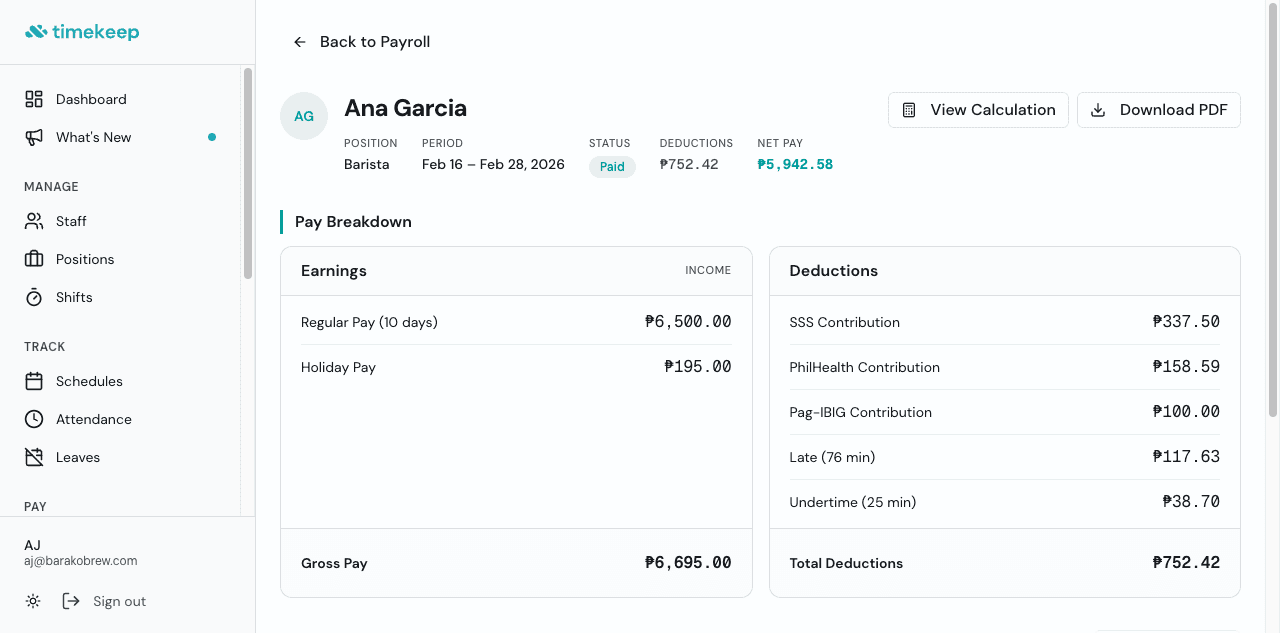
Timekeep stores the current SSS contribution table and matches each staff member's compensation to the correct bracket when you run payroll. The employee share is deducted, the employer share and EC are tracked separately for your remittance, and when SSS publishes a new table, Timekeep updates accordingly. No spreadsheet formulas to maintain, no bracket lookups to do by hand.
One less thing to Google every cutoff
The SSS table doesn't have to be the thing that slows down your payroll. Understand the brackets once, make sure your numbers stay current, and the rest is just looking up the right row. Or let the system do the lookup for you.
Try it free for 30 days at timekeep.ph. No credit card required.