
Mar 25, 2026
Undertime vs Tardiness in Philippine Payroll Rules
The difference between undertime and tardiness in Philippine payroll, how each affects pay computation, and how to set fair policies for your team.
You're reviewing attendance before running payroll. One staff member was 15 minutes late three times this week. Another one left 30 minutes early on Tuesday because her child got sick. You're about to deduct the same way for both, but something feels off. Are these really the same thing?
They're not. Tardiness and undertime are two different issues, and treating them identically creates confusion for your team and inconsistency in your payroll. Here's how to handle each one properly.
What's the difference
Tardiness is arriving late. If the shift starts at 8:00 AM and someone clocks in at 8:15 AM, they're 15 minutes tardy.
Undertime is leaving early or working fewer hours than scheduled. If the shift ends at 5:00 PM and someone clocks out at 4:30 PM, that's 30 minutes of undertime. It can also apply when someone takes an extended break that cuts into working hours.
Both result in fewer hours worked than scheduled, but they happen at different ends of the day and often tell you different things. Habitual tardiness is usually a behavioral pattern. Occasional undertime is often situational, a sick child, a personal errand, an approved early departure.
How each affects pay
The basic principle under Philippine labor law is "no work, no pay." If a staff member doesn't work for a portion of their scheduled hours, the business is not required to pay for that time.
Tardiness deduction
Most businesses compute the deduction based on minutes late. If the daily rate is ₱700 and someone is 30 minutes late on an 8-hour shift:
(₱700 / 8 hours / 60 minutes) x 30 minutes = ₱43.75
Undertime deduction
Same formula. If someone leaves 1 hour early:
₱700 / 8 hours = ₱87.50
Some businesses use a per-minute rate for both. Others round to the nearest 15-minute or 30-minute increment. Whatever method you choose, apply it consistently and make sure your team knows how it works before enforcement starts.
Grace periods
Most Philippine businesses offer a grace period for tardiness, typically 5 to 15 minutes. If the grace period is 15 minutes and someone clocks in at 8:10 AM, no deduction is made. If they clock in at 8:16 AM, the full 16 minutes are deducted.
Grace periods are a company policy, not a legal requirement. DOLE doesn't mandate them, but they're standard practice and help avoid disputes over minor clock-in differences caused by queues, traffic, or a slow kiosk.
Undertime grace periods are less common but follow the same logic. If your grace period is 5 minutes and someone clocks out at 4:57 PM on a shift that ends at 5:00 PM, some businesses treat that as on time.
The key is consistency. Apply the same rules to everyone.
DOLE guidance on fair policies
The Department of Labor and Employment (DOLE) doesn't prescribe a specific tardiness or undertime policy. What it does require is that policies are reasonable, communicated to staff, and applied consistently.
Deductions should be proportional. You can deduct pay for time not worked, but you can't impose penalties that exceed the value of the missed time. Deducting two hours' pay for being 10 minutes late would not hold up.
Policies must be communicated. Whatever your rules are, staff should know them before they're enforced. A written policy in the handbook or employment contract is the standard.
Progressive discipline for habitual offenders. A single instance of tardiness shouldn't lead to termination. DOLE expects a progressive approach: verbal warning, written warning, suspension, then termination. Each step should be documented.
Building an excusal workflow
Not every instance of tardiness or undertime is the person's fault. A flat tire, a sick child, a sudden errand approved by the supervisor. A good attendance policy includes an excusal process.
The staff member or their supervisor flags the tardiness or undertime as excusable. A manager reviews and approves or denies the excusal. If approved, the deduction is waived for that instance.
This keeps the policy fair. The automatic deduction is the default, but there's a clear path to override it when circumstances warrant. The record still shows what happened, but notes that it was excused.
Why tracking them separately matters
If your system only records "hours worked" without distinguishing between tardiness and undertime, you lose visibility into patterns. Someone who is consistently 10 minutes late every day is different from someone who leaves 30 minutes early twice a month. The first is a behavioral issue worth addressing. The second might be an occasional personal obligation that barely affects output. Separating them in your records makes the difference visible.
How Timekeep handles tardiness and undertime
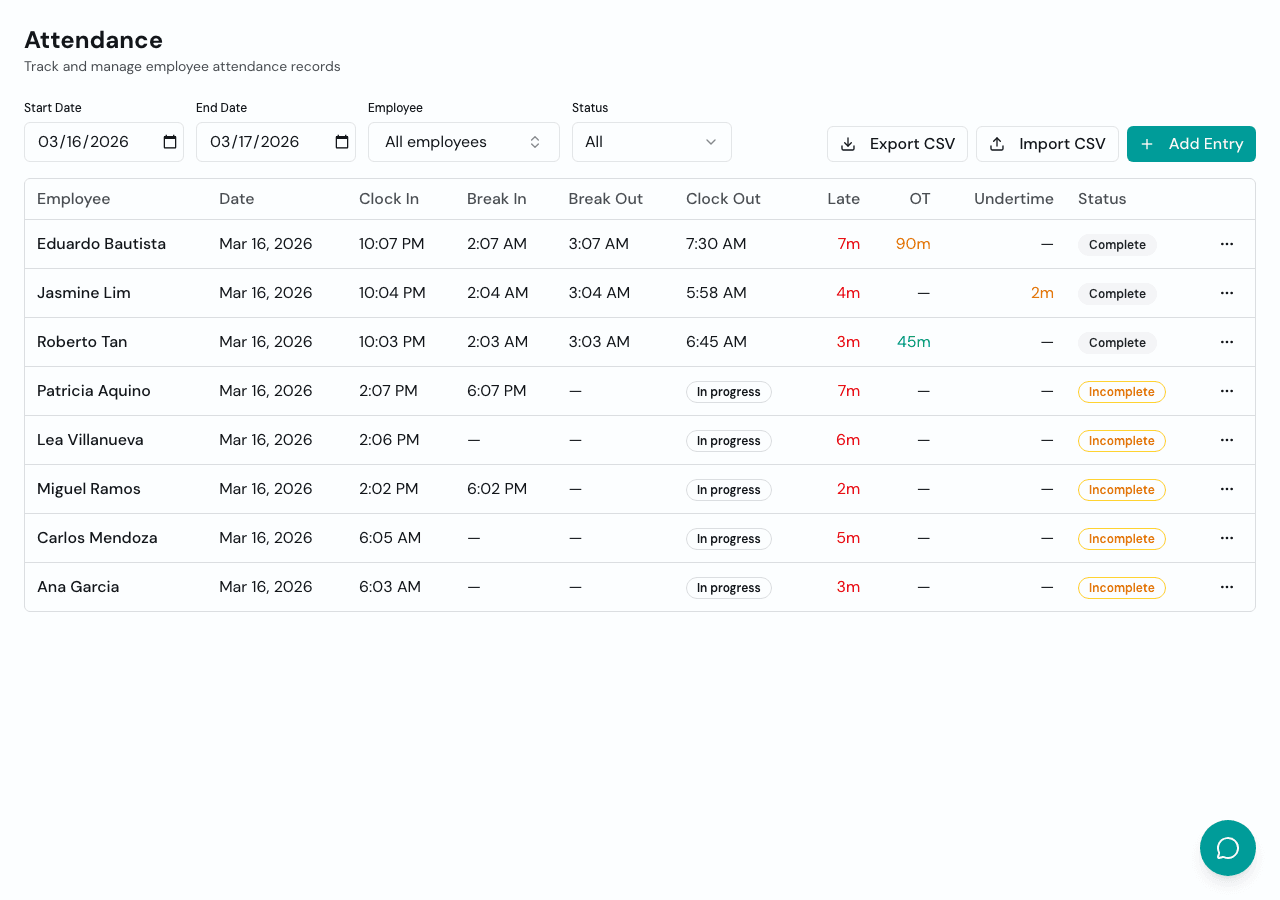
Timekeep tracks tardiness and undertime as separate line items on each attendance record. When someone clocks in late, the tardy minutes are computed against the scheduled shift start. When they clock out early, undertime is computed against the scheduled shift end. Both have configurable grace periods and deduction rates. Either can be excused by a manager, and when excused, the deduction is waived but the attendance record still shows what happened and who approved the excusal.
Fair, consistent, and visible
The staff member who was 15 minutes late three times and the one who left early for a sick child are two different situations. Your attendance policy should reflect that. Define the rules, communicate them, apply them consistently, and make sure there's a way to handle the exceptions. That's what keeps it fair for everyone.
Try it free for 30 days at timekeep.ph. No credit card required.